Nurtured by Love

Year: 2023

  • Bikeaversary 2

    Bikeaversary 2

    I’ve now been car-free (locally, meaning for distances of under about 40 km one-way) for more than two years. The second anniversary slipped by without me even noticing. I no longer feel like I’m out to prove something; it’s just become second nature that this is how I live my life.

    I ordered studded tires for the new bike and I think these will work much better in the snow than the noisy somewhat finicky chains I had to use on the Rad Mini’s non-standard tire size. Incidentally, the Rad Mini has been passed along to a local friend who is not a winter rider and who rides mostly flat terrain around the village. With a new wiring harness it seems to be running well for her and I’m sure happy that it hasn’t had to go directly to a landfill.

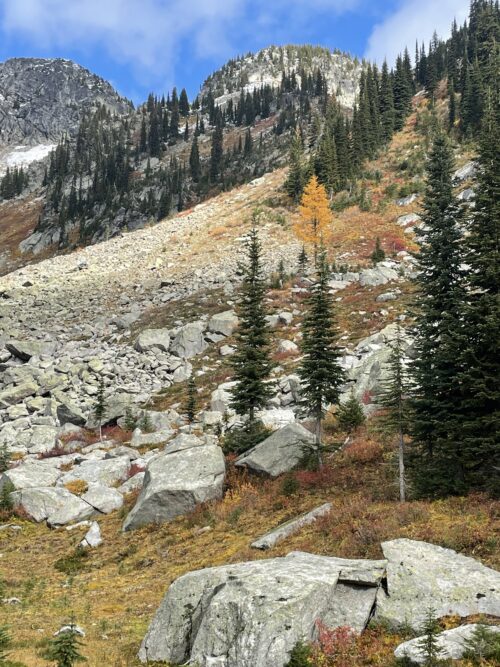
    The other day I decided to try out a newly rehabilitated trail in the northwest corner of Kokanee Glacier Park using a recently reopened forestry road for access. To get to the forestry road I had to ride about 20 km from home along the highway to the top of a long hill. I had been assured that the gravel forestry road, just over 12 km long from that point, was in great shape, so there was no reason not to use the e-bike to get to the trailhead. As it turned out it was a great choice.

    The 32 km of mostly climbing did give me a twinge of range anxiety. Adding in four hours of alpine hiking, I knew that the climb up the hill back to my house would come at the end of a 7-hour day of non-stop exertion, and I did not want to be running out of bike battery at that point. Having not done a lot of really long rides on the new e-bike I wasn’t sure how much of a cushion I would have, so I kept the power assist either off or — when climbing — on the lowest setting. As it turned out, there was plenty of juice, but I didn’t know that in the morning. Better safe than sorry.

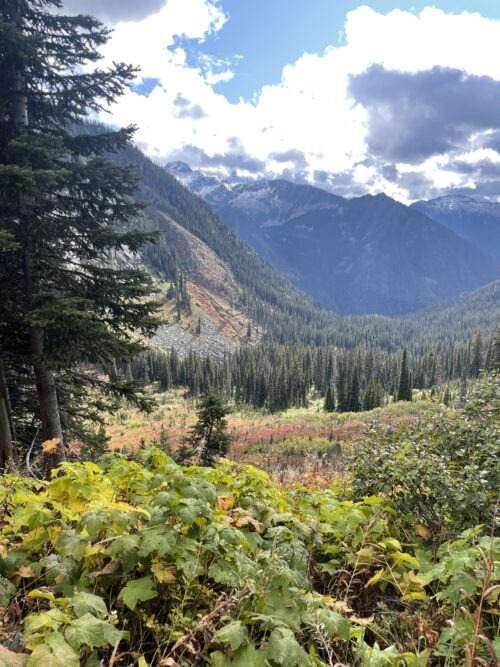
    The Roadster turned out to be a very capable Logging-Roadster too. Nice gravel-style tires with a fair bit of volume, some front-fork suspension and a suspension seat-post kept me very comfortable. The hike itself was amazing, though fairly steep, meaning I used muscles on the descent that I don’t stress very often, and I’m a bit sore 36 hours later. But it was worth it to spend a crisp sunny day getting into a beautiful alpine basin that will like get snowed in within a couple of weeks.
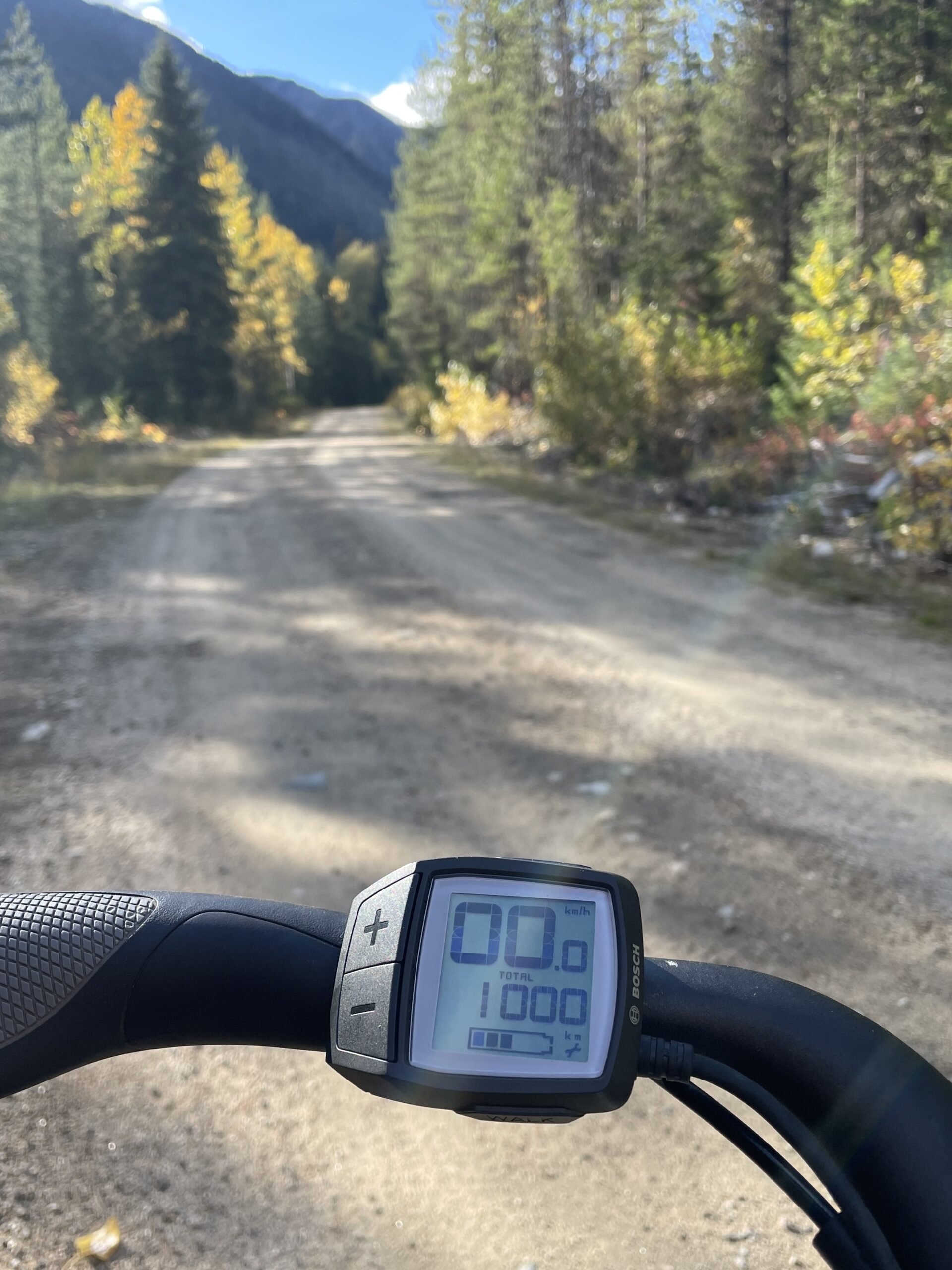
    Because I was away from home and e-bike for half the summer, it took me until this week to clock 1000 km on the Roadster, and the moment came along the forestry road leading toward Blue Grouse Basin. A great location and a great day for a first major milestone for this bike. Looking forward to many more thousands.
  • Tiny book

    Tiny book

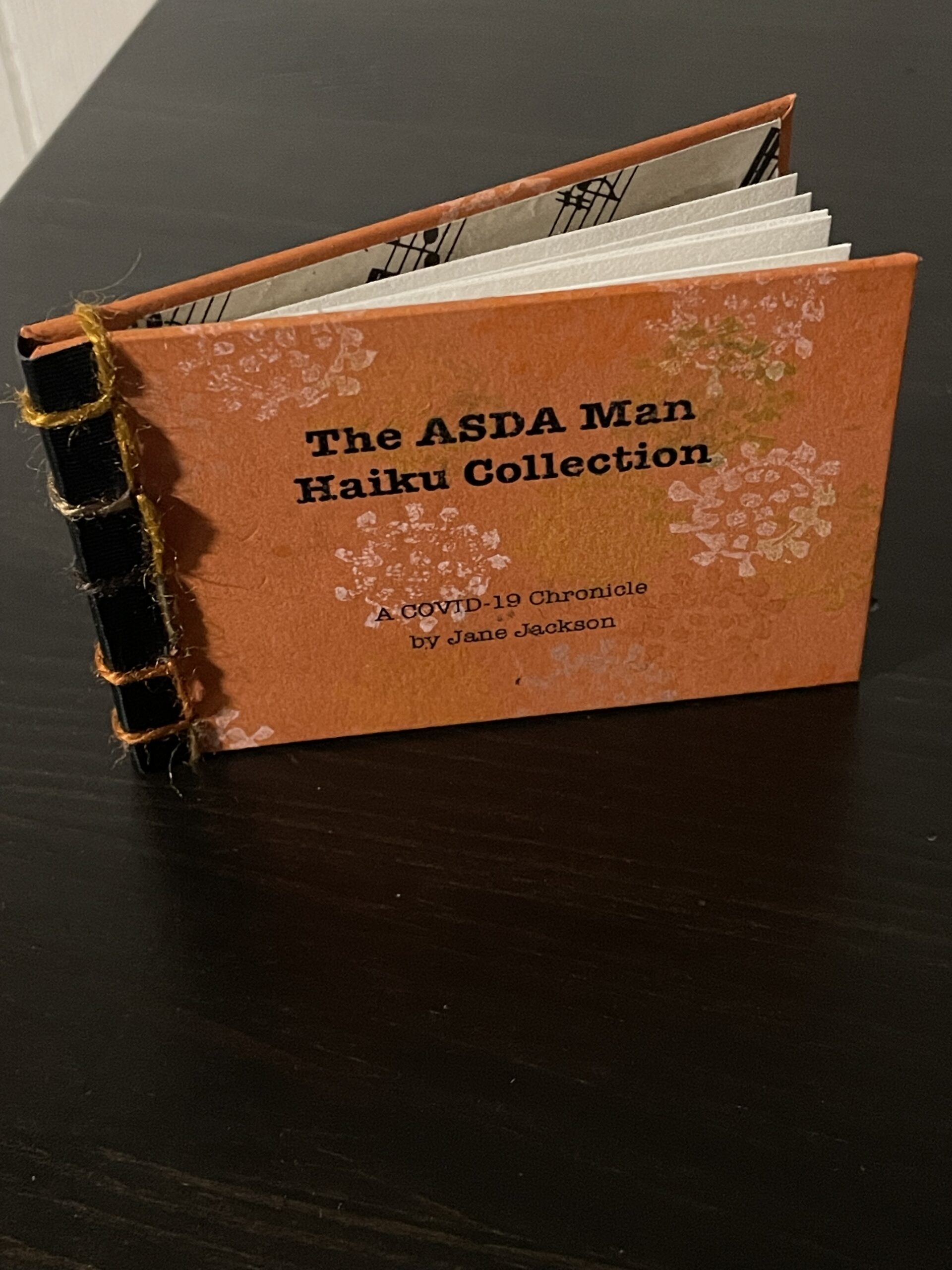
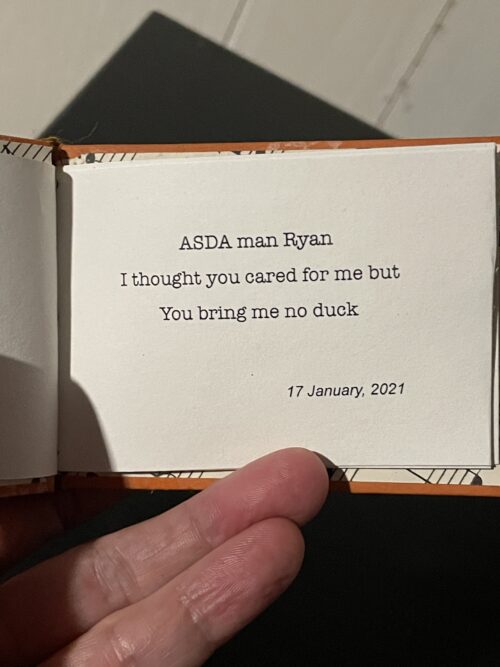
    Made for an online friend who “published” a series of haiku during the early phase of the pandemic, interspersed with countless other Facebook posts, so that only the observant noticed the pattern.

  • An Apparent Evergreen

    An Apparent Evergreen

    In spring
    did they notice
    that alone among the conifers
    you were fully cloaked
    trunk to twig
    in feathery tassels of new green?
    While other trees
    merely added pale buds to branch-tips ,
    did they see that you lacked
    their staid dark under-cladding?

    Perhaps they did
    but in summer you stood in the copse
    like one of the rest,
    an apparent evergreen,
    your trunk driving towards the mountain sky,
    needles dark and firm like any proper pine or fir.
    Any suspicions they’d had were put to rest
    as you set about the photosynthetic business of being a tree.
    Making roots and cones and twigs,
    you exhaled oxygen,
    and soon you too forgot your odd feathery spring.

    Yet as the nights grew crisp
    your suspicions grew
    that you were not, after all, the same as the rest.
    Your mid-summer energy spent
    your needles slowly brittled.

    And suddenly one cold morning you were certain
    that you were not to be ever green after all.
    You burst into the frost-days of autumn
    a fiery yellow larch,
    starkly different,
    unapologetically so,
    shouting your gold
    across the high mountain slopes
    to others of your kind:
    I’m here! I’m not like the rest! See me!

  • R&M Roadster: Early Review

    R&M Roadster: Early Review

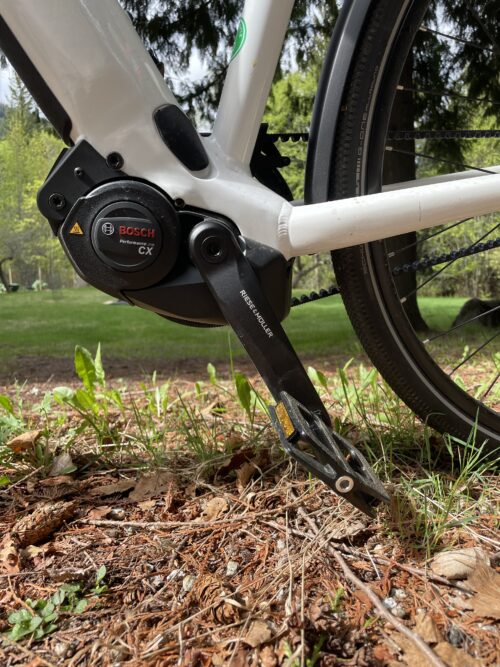
    I put a lot of thought into my recent e-bike purchase, informed by two years of all-season riding of my previous e-bike. Those two years also made it clear that I was not just purchasing a bike, but a car replacement. Because of that, I recalibrated my budget upwards. I ended up buying a German-made urban-style bike with a mid-drive Bosch motor, internal hub gearing, and a carbon belt drive. I test-rode it in Toronto and had it shipped to meet me back home. My 2022 Riese&Müller Roadster arrived a couple of days after my 60th birthday. Being last year’s model and bike shops generally having too much inventory, I got a great deal on it, but it still cost approximately three times what we paid for the Rad Mini!

    I’ve had the new bike for a couple of weeks now, and with 200 km on the odometer under a variety of conditions, here are my impressions so far:

    It feels like a piece of modern German engineering: sleek and efficient and powerful. Although its peak power is actually a little lower than the Rad’s, it feels more powerful, and it functions beautifully under load. That’s the magic of a mid-drive motor as opposed to the hub-based motor the Rad had. Just as a person without a lot of strength can pedal up a hill by shifting to a lower gear, a mid-drive motor enjoys the same gearing advantage. The bike doesn’t necessarily go all that fast up hills especially while heavily laden, but the motor happily hums along, rather than moaning at low RPM and ultra-high torque like the Rad used to. So I love the mid-drive motor and I am sure it will last for ages.

    The next big difference is in the way the assistive power is calculated and applied. The Rad’s power assist was simple and additive. In Eco mode, you would receive an additional 100 watts of power as soon as the pedals started turning. One notch up would give you 200 extra watts, and so on. There wasn’t much finesse to it and there would be a bit of a lurch as the assist kicked in or notched up: kind of an on/off-switch effect.

    With the R&M Bosch system, the power assist is scaled and responsive. The harder you pedal, the more the bike assists you, thanks to a torque sensor and some math. I would estimate that the scale probably results in about 1.5 times your pedaling power in Eco mode, 2 times in Tour mode, 2.5 in Sport and 3 in Turbo. There’s some nuance to it thanks to additional sensors: when the wheel is turning very slowly at start-up, you get a couple of seconds of greater assist, and when you change your gearing to increase your pedaling cadence, there’s also a wee bit of extra juice provided.

    The upshot of the responsive assist isn’t just a more natural feel and less lurching, though it certainly does give that. It also seems to have a really useful psychological effect, at least for me. On the Roadster, pedaling harder is an easy and intuitive way to ask the motor for more help. I don’t have to change assist level settings if I hit a hill: I just pedal harder, and the bike magically provides more help. And so this is what happens when I am mindlessly riding along: I work a lot harder than I used to on the Rad. Not that I have to work harder; it’s just that I tend to naturally and intuitively choose to do so.

    The other really noticeable difference is in the geometry of the bike. The Roadster is, as its name implies, designed for roads rather for trails and it’s an upright bike intended to let you see and be seen on the road. The wheels are 650B, so pretty large diameter, and the tires are inflated to higher pressure and lacking the knobby tread you’d need to handle loose dirt and mud. With the weight of the motor low down in the centre of the bike, its handling is much more stable at high speeds. As I typically hit 60-65 km/h coasting down the hill that connects my home to the village, I love that I no longer have to apply the brakes to quell the dangerous front-wheel shimmying I used to experience on the Rad. Additionally, the much lower rolling resistance and lighter weight of the Roadster mean that it coasts beautifully, and on flatter terrain I don’t usually use any assist at all. It feels like a marvelous and efficient normal bicycle.

    A few other features I love:

    • front and rear lights are both bright, and integrated with the battery and the controls
    • proper mudguards: I no longer end up with road spray and grit between my teeth!
    • the Snapit connectors for the Racktime rack that allows me to swap out different cargo configurations
    • the Abus frame lock and chain, since I finally have a bike that I feel I should be locking up even here in our wee village
    • the incredibly quiet belt drive
    • the “little guy” on the grip-shift gear controller: instead of a numerical gear system, there’s a pictogram of a little guy riding up a hill and the steepness of the hill changes mechanically as you shift

    Overall the Rad felt like a motor with wheels, but the Riese & Müller Roadster feels like a bicycle, with superpowers. Since I love bicycles a lot more than I love motors, I’m in heaven.

    The hydraulic brakes, the belt drive and the internal hub gearing are the features that will really come into their own next winter, so in-depth thoughts on those will have to wait.

  • Search for a winter-worthy e-bike

    Search for a winter-worthy e-bike

    After two years of making do with the Rad Mini I’ve decided to upgrade my e-bike. The Rad is the inexpensive hub-drive bike we bought to help Fiona get around Nelson on her own. After she graduated from high school it languished for a year or so until I took it over in 2021, making it my primary means of local transportation.

    But not only is it ridiculously heavy, it has also been very difficult to use and maintain in winter. The weirdly small-but-fat wheels don’t have any studded tires available to fit them. I bought tire chains, but wore them out. The exposed drivetrain (chain and gearing sprockets) are always wet and coated in the sand and salt that are used on the roads here in the winter. The mechanical brakes and exposed shifting mechanism are prone to icing up. And while I spend ten minutes every time I arrive home spraying, wiping, lubing and wiping the moving components (yes, even at night when it’s ten below in the garage) rust and corrosion continue because I can’t get the bike dry. With the rack and other extras it weighs 85 lbs, and bringing it into the mud room would involve stairs, so that doesn’t happen. And obviously I can’t do the cleaning and lubing when I’m away from home, say for a meeting or a shopping trip. So oxidation and abrasion continued to have their way…

    With hundreds and hundreds of charge cycles, the battery had reached its end of life as well. While I got nowhere near the lifetime mileage out of the battery that the manufacturer claimed was possible, this was no doubt down to the hard use I have put it through: a three-kilometer 5-13% uphill grade every time it returns home, typically laden with cargo, and using it at for a good part of the year at temperatures well below optimal. Recently the battery had been acting strange, suddenly slipping to half or a quarter of its charge, occasionally leaving me entirely in the lurch, playing random games with the headlight (and boy-oh-boy are the nights dark here when the headlight quits!).

    I had been pining for something more suited to my needs, and so a few months ago I made a list of attributes my next e-bike should have:

    • Removable battery (batteries need to be charged at room temperature)
    • ~ 70+ nM of torque for my climb home with groceries i.e. a powerful mid-drive motor
    • Torque-sensor assist rather than simple pedal-rotation-sensor (much more natural)
    • Carbon belt drive (no corrosion, no lube/grease on clothes)
    • Internal hub with wide gearing range (ditto)
    • Hydraulic brakes (no cables icing up like with mechanical brakes)
    • Standard-sized wheels (not small, not fat) for use with studded tires, and for better stability on fast descents (the Rad picks up a wobble at 35 km/h)
    • Available small frame size (most e-bikes are best suited to people over 5’7″ which I’m definitely not!)

    Bonus items:

    • heavy-duty rack
    • integrated headlight/taillight
    • fenders, kickstand
    • lighter weight

    With the Rad’s battery nearing its end of life, rather than spending far more than the residual value of the bike itself on a replacement, I decided that since for me an e-bike is my primary means of transportation year-round, it was time to buy a bike for me, and for my style of use. I started researching early in 2023.

    Sadly most of the bikes produced for the North American market are sport- and recreation-focused, rather than being optimized for all-weather transportation. The belt drive / internal hub gearing in particular was a very difficult feature to find domestically.

    But eventually I found a couple of Canadian shops specializing in importing European bikes. One of the shops is situated less than a 30-minute walk from where Fiona lives in Toronto, so the last time I visited her, I made a stop at Curbside Cycle. I was thrilled to discover that they still had the bike I had had my eye on: a size-small Riese & Müller hybrid commuter-style bike left over from last year and heavily discounted. One very short and very thrilling test-ride later, it had my name on it and was put in the queue for shipment to BC.

    Then last week the Rad’s battery spat and popped and that was the end. Goodbye, battery. Thank goodness my replacement bike had already been identified, sourced, bought and paid for!

    The R&M bike is still on its way across Canada to me, expected in about a week. It’s been challenging getting by with only my ‘acoustic’ bike or on foot in the cold end-of-winter rains. Walking the route from town takes an hour, non-electrified cycling half an hour, and both of them call for a shower afterwards because of the exertion required to get up the hill to home. But soon … sooooonnn…

  • The orange pill

    The orange pill

    During the summer of 2021, Fiona was offered a job working as a veterinary assistant at a clinic 50 km away. It was a super opportunity, so I told her she should take it, and she could use my car for the commute. I would use the e-bike. We had bought a Rad Mini in 2018 to help Sophie and Fiona get around for work, school and groceries in Nelson while they were living semi-independently. They mostly walked but the bike was occasionally a huge help.

    Once Fiona moved away to university in the fall of 2020, the e-bike came home to live in the garage in New Denver and only occasionally got used. But the following spring, with my car leaving town 5 days a week, the e-bike became my primary vehicle for errands. It was suprisingly enjoyable. It could pack a fair bit of payload, and I felt much less guilty making my little runs up and down the hill to the post office or grocery store most days. So when she went back to Toronto for her second year of university, I decided to see if I could keep using the bike for local trips, at least until the cold rain started in October.

    I decided that for every tank of gas I didn’t have to buy, I would flesh out my cycle-commuter kit. I got myself some rain pants and I made it through October. I figured I’d keep going until the snow was flying. I was surprised to discover that the tire tread was pretty good in the first skiff of snow. I added an under-helmet balaclava, a set of warm waterproof gloves, some goggles, and a hi-vis jacket.

    Suddenly it was April. I had ridden through the whole winter.

    And so I kept going. I lent my car out to people who needed a car. I used it myself for trips of over 100 km (for orchestra gigs, to retrieve various children from airports to bring them home or to dispatch them, for appointments in Nelson) but for everything local, meaning everything within 15-20 kilometres, I used the bike.

    It was addictive! I was thrilled with how fun and easy it was. And then I discovered NotJustBikes and swallowed the orange pill for once and for all.

    NJB is a YouTube channel by a Canadian guy who grew up in the same general area of the country that I did, and who now lives in Amsterdam. His dryly sarcastic video essays talk about the differences in transportation norms and urban design between North American cities and those in the area he now lives.

    Spoiler: we don’t come out looking very good.

    I fell down the rabbit hole of his YouTube channel and found myself alternately inspired and frustrated by the contrasts. It was a sort of “I never thought about it, but the way we live really sucks, and there is no good reason we can’t radically change things” experience. And a lot of “omg, why do we still insist on doing things so stupidly, when so much of the rest of the world has been doing them so much better?” And repeated sentiments of “why do we just accept this shit?” This is the orange (Dutch) pill.

    I don’t know what the magic sauce is that makes the orange pill go down so smoothly, but I cannot recommend his channel highly enough. It is definitely a gateway drug.

    So here I am another winter later, still only using the bike for local transportation. I now have a cargo trailer, made out of the old kids’ Burley D-Lite trailer, which I can hook on for bulky loads. I have pogies (bar mitts) and a better high-visibility winter jacket. I have the bike tricked out with a go-mug holder, tire chains for the icy days, slick tires for the summer, a phone mount and rear blinkies that function as turn signals. It’s getting close to the 4000-kilometre point on the odometer, which isn’t all that much compared to the mileage I put on my road bike, but it is a ton of riding when you take into account that it is made up almost entirely of 3.5-kilometre trips up and down the hill between our property and town.

    And I am now a passionate advocate for active transportation options. I organized an e-bike event at the local market last summer to encourage other people to look to e-bikes as a transportation option. (Several have since done so!)

    I have also taken on the challenge of trying to develop a shared-use active transportation trail between our village and the next one over, something that has been tried repeatedly over the years. They’re only 4 km apart but the highway is so dangerous for anything but motor vehicles that everyone is car dependent as a result. I’ve waded into the worlds of municipal politics, public advocacy and grant applications as a result, places I would ordinarily avoid like the plague, but the orange pill is making me do it.