Nurtured by Love

Year: 2014

  • Orange is the new black

    Orange is the new black

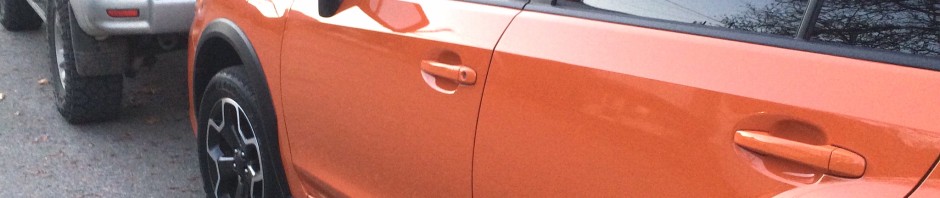
    So we got a new vehicle. Compared to the old one it’s less boxy, less black, cuter and smaller. It’s also less backwards, having the steering wheel on the left, a fact that makes my three (yes three!) kids with Learner’s Permits much happier. I think that we now have some hope of actually getting one or two of them to the next stage of licensure.

    IMG_0008The new car is a five-seater Subaru CrossTrek. Now that we’re rarely a family of six, or even five, we no longer needed the passenger space the Delica offered. Since the Deli was reaching its 21st birthday and beginning to show its age, we decided to opt for something newer, smaller and more fuel-efficient. I love the CrossTrek so far. It gets an extra 160 km from a tank of fuel compared to the Delica (and it was actually pretty good) and has the high ground clearance and AWD that are necessities where we live. Furthermore it has all sorts of nice safety features like airbags, ABS and traction control, things that are pretty standard these days but which the Deli was missing.

    IMG_0011So we’re a three-L family, and I think we’ll be hard-pressed to share the driving experience out over the holidays. By rights Erin and Noah should already by onto the next stage in the graduating licensing, but it hasn’t happened. I really don’t know what it is about this generation that they don’t relish getting their driver’s licenses the way my generation did. It may be that this is regional, and that in other parts of the country it’s different. But here, there doesn’t seem to be a headlong dash towards learning to drive the instant kids turn 16. A few kids, sure, they’re in a hurry but a lot seem to have no interest. For my kids and the majority of their friends it’s just not a priority.

    I wonder about a few factors. First, the graduated license program, which I completely understand the reasoning behind, has had the effect of pushing full licensure out of the high school years. In BC if you move quickly, you can have a partial license as early as your 17th birthday, but full licensure (meaning being able to carry more than one passenger without restrictions on time of day, etc.) has to wait until well into legal adulthood. So driving just isn’t part of the high school culture. Kids don’t see their slightly older friends enjoying the perks of being fully licensed, encouraging them to look forward to becoming so themselves.

    Then there are the economic constraints. When I was 17, gas cost 23 cents a litre. Around here we’ve been paying more than five times that much. Inflation only accounts for about half that change. So cars are more expensive to buy, insure, fill and maintain, even taking inflation into account, and higher education costs more than ever. How likely is it that a university-bound young adult these days will own a car? Not very!

    And then there’s other fallout of the graduated licensing system: it makes it expensive and inconvenient for teens to get enough practice to prior to doing their road tests, since (at least in our case) they’ve moved away from home by the time they’re age-eligible. Living in big cities, with ample public transit, thankfully, on shoestring budgets and with no access to a family vehicle, they are mostly limited to few weeks of rural driving in the summer to get the driving experience and confidence they need to do their first road test.

    (I should say that I have a similar beef with the practice in some jurisdictions of pushing the legal drinking age well into adulthood — particular as old as 21. It means that it’s difficult for parents to provide support and guidance as their offspring venture forth into these new areas of responsibility. Hey kids, there’s something we think carries a bit of risk, so we’re not gonna let you try it until you’re a bit older and completely on your own.)

    Finally, for my kids at least, there’s the fact that they’ve had a lot of autonomy and independence already. Erin travelled to SE Asia, and took herself to Alberta once a month when she was 14 and 15. Noah went to Cuba as well as various other Canadian locations with his choir and has couch-surfed a bit in Nelson. Sophie’s already living on her own a few days a week. All three kids made their own educational choices, whether as unschoolers or by choosing to attend school. Maybe a driver’s license doesn’t have the same symbolic value for them as a marker of the passage into independence and autonomy.

    At any rate, it’s not part of high school culture because you now have to be older, and that makes getting enough learn-to-drive experience is awkward and expensive, and my kids have already got a fair bit of independence, so what’s the big deal with driving? Why bother to learn? In our case if you then add the disincentive of learning in a boxy high van with the steering wheel and controls all on the wrong sides and you’ll understand why we’re all stuck at the L stage here.

    It turns out it may be Sophie pushing the older siblings forward here. She turned 16 recently, got her L and has actually seen the wisdom in knocking off as much of the learn-to-drive process as she can while she’s still living at home, even if the payoff may end up being many years down the line. Perhaps several years after graduating from university she’ll finally having enough income to buy her own car, and won’t have to pay to take a several-months-long Driving School course at that point.

    She’s pushed herself past the “freakin’ stressed out” stage of being behind the wheel and is now to the point of enjoying our lonely rural drive back and forth from Nelson. She’s getting experience with all kinds of weather and is learning to keep her eyes peeled for black ice and deer eyes glinting in the dark. What she’s not getting enough of yet is dealing with traffic patterns in city environments, but Nelson is big enough that she’ll accrue that over time.

  • Getting around

    DSC04780Here’s our minivan. We bought it about 18 months ago and it transformed my driving experience. It made access to alpine hikes a breeze. Road trips and drive-in movies were awesome. I loved not having to hike in from the highway end of our driveway even once last winter, and knowing that winding mountain roads covered in snow were safer with our 4-wheel-drive and high ground clearance. The right-hand drive was easy to get used to, and while there are more and more of these beasts in the area, I also loved the mildly eccentric aura that it created around us. Fuel mileage has been pretty decent, and it’s a spacious and comfortable vehicle for five or more.

    But the Delica is showing its age (it’s a 1994), especially since we’re such mileage-hogs. Our at-home family is smaller now, and I’m not driving five teenagers to choir practice anymore. In another month all three of my older kids will be in possession of driver’s Learners Permits (Erin and Noah having delayed attaining their full licensure due to a combination of temperament and lack of proximity to home). And really, what is the wisdom in having beginning drivers learn their basic skills in a right-hand-drive vehicle? So we’re planning to sell it and buy something new or new-ish. Something with all-wheel drive, but smaller and cheaper to maintain, considerably more fuel-efficient and with the driver’s seat on the left. I also like the idea of having airbags again. I’d like a few airbags. Hoping to make this a reality before winter hits full-force, since this is a pretty good time of year to be selling a snow-trampling monster minivan.

    IMG_0042We’re now spending part of each week in a city. When we get to Nelson, we’ve been trying to leave the van parked at the house, and walk as much as we can. It’s been so much fun to poke our way around amongst the secret stairways and paths in a city where the terrain makes drivable roads a bit of an engineering challenge. Our house in Nelson is a mere 750 metres from downtown, but 100 metres above it with most of the elevation gain taking place over just 400 metres. Just getting home is a workout, and it’s a workout we tend to do at least a couple of times a day. The sidewalks run places roads can’t, and we love the feeling of winding our way amongst lovely homes and beneath hardwood trees with changing leaves, up “sidewalks” like the one pictured above.

    So we’re spending three days a week in a walkable city, and when we’re home we hardly need to drive at all. We’re still doing two trips a week to Nelson, but soon that will be in a much smaller vehicle that gets double the mileage. Our carbon footprint should diminish dramatically in size this year.

  • Xeroshoes

    Another review in the gear-and-gadgets vein.

    First I made my own huaraches. That was really fun, and they worked well enough, but I didn’t have quite the right sole material. The soles were thick enough but not rigid enough. They flopped and slapped, and if I didn’t have them laced fairly tightly the front end would flop down during my stride-through and I would sometimes catch the toe end: not fun!

    Then I bought a pair of Luna Sandals, looking for something more rigid for rougher trails. Maybe some of their models are great, but I went too much to the other extreme and bought the Leadvilles which were far too rigid and clunky for my tastes. I still own them, but I honestly can’t imagine a trail that would be so rough that I’d take them over a more minimalist sandal: you really can’t feel anything through them. Miles and miles of sharp scree, maybe. Typical rough and rocky Kootenay back-country trails? Naw.

    IMG_1152
    Amuri Cloud: slight heel cup, and one of the lacing adjustment sliders

    Finally last fall I bought a pair of Xero Shoes Ventures. They are sort of a hybrid between a flat basic home-made-style huarache and a manufactured sandal. The have techie lacing fittings and slightly engineered soles and a manufactured toe post. But they’re super light and thin, and just barely rigid enough to avoid the toe-catching and slapping sounds I got from my home-made jobbies.

    I really liked them, and used them for casual wear, beach and boat stuff, regular runs, trail runs and hiking. Until a couple of months ago, when one of the toe posts fell apart for no apparent reason. I was sad. I had really wanted to like them. I couldn’t decide what to do. I know runners in conventional shoes trade their $120 shoes out every six months or sooner, but as a minimalist runner I thought I was done with that hamster wheel.

    IMG_1151
    Once the laces are adjusted they work as slip-ons. The black area is the foam, the brown the solid rubber.

    Finally a couple of weeks ago I figured I might as well write to the company to ask about buying replacement toe posts. They were fabulous. They apologized profusely for the problem I’d had, said they hadn’t had much of this problem but no manufacturing process was ever completely free of defects, and they would like to send me a free replacement pair of sandals — but could they talk me into their newer Amuri Cloud style, which was a little bit lighter with part of one are of the topsole replaced with thin foam. Sure, I said!

    They arrived within a few days, no small feat considering where we live. And I love them even more than I loved the Ventures. Partly because of the slight cushioning and better grip and breathability of the foam, and partly because I like the mocha/black colourway.

    IMG_1150
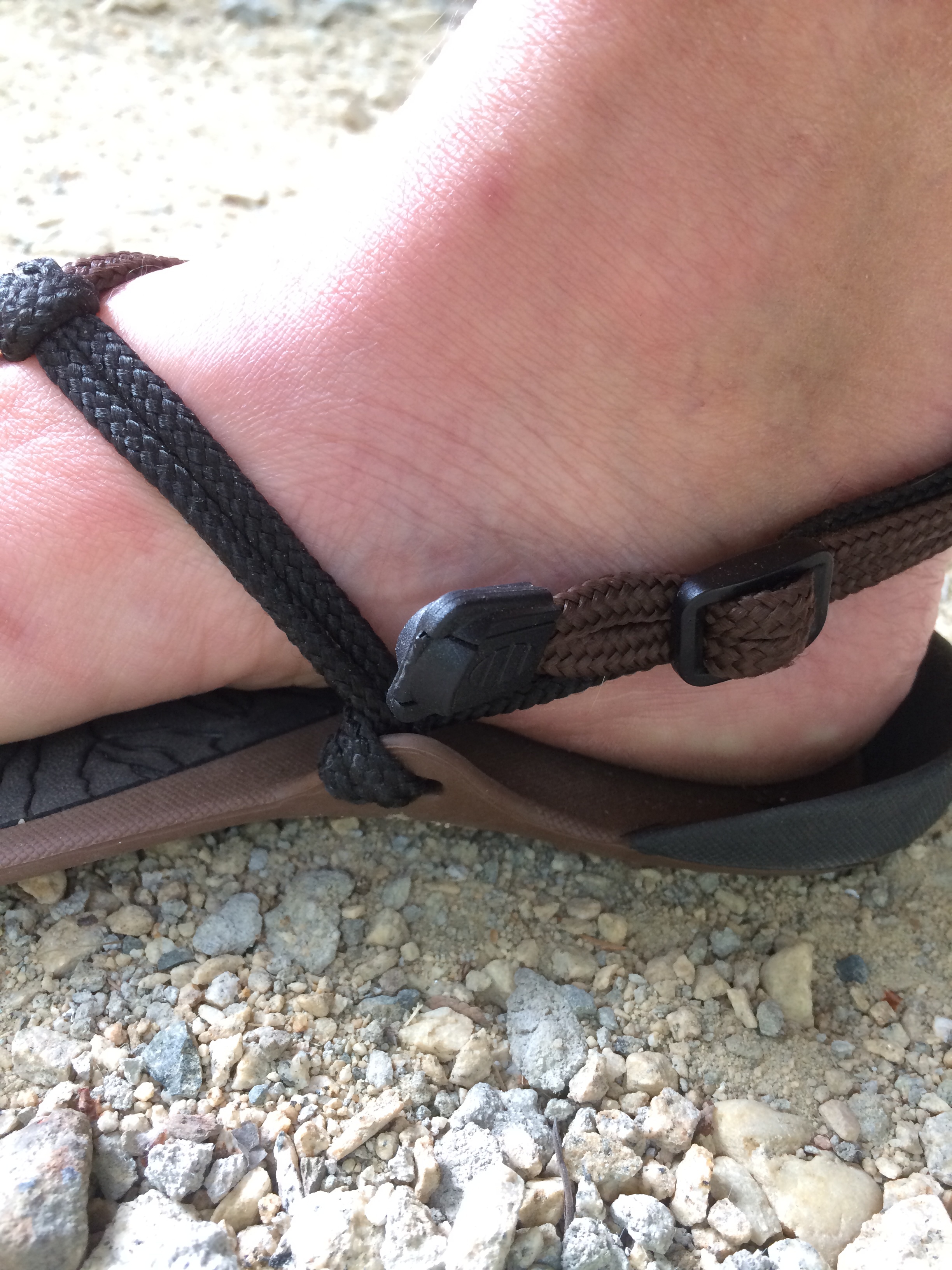
    Gentle but secure lacing — finally!

    I should say that I found both my original Xeros and these new ones quite frustrating to get adjusted at the beginning. You can adjust the overall tightness of the laces, but by sliding the knot you can adjust the angle of the forefoot lacing, and by pushing or pulling the laces through the side-holes you can adjust whether the tightness is more in the forefoot or heel. There’s no real science to what works to prevent excess tightness and discomfort while keeping the heel straps from slipping off. Maybe other people have less trouble than I do. My foot is relatively narrow and tall so perhaps I have an especially small window of optimal fit with this type of lacing. I’d think I had it, but then I’d go for a run and the heel strap would slip down, or I’d get a pressure hot-spot from the knot. Try again. Different problem. Try again.

    But eventually I found it, the optimal lacing tension for me. Barely on, but always on. They’re my favourite footwear. I didn’t use them for the circle route because I know that when I haven’t done a lot of recent running in huaraches I get horrid blisters in my toe web-space if I run too long in them. Since these are new, I didn’t have time to acclimate to them. But next time — yeah!

  • My Fitbit

    Fitbit Flex
    Fitbit Flex

    It’s an activity tracker, a value-added pedometer. I bought it about 15 months ago. I got it as a way to be less obsessed with tracking the minutiae of my exercise. With my old Garmin (has it really been five years?!), which is bulky and a bit uncomfortable to wear, I tended to geek out and get all micro-analytical when presented with the detailed real-time information about distance, pace, speed, slope, calories and heart rate. It fed into my self-competitive tendencies, and I would find myself running too fast or too far, just to make the next round number. 5k in 25 minutes, or 10k today instead of the 7.2 that feels about right, or a negative split on the second half of the run. That tended to lead to injury and to focus on the data record, with less enjoyment of the actual running. The graphs were beautiful, but distracting.

    I wanted to focus more on the experience of running. For a while I ran completely ungadgeted. I had dropped the iPod quite early on, but dropping the data was a big change. It was lovely when I was motivated to run, but sometimes I felt I needed a little prod to get out the door. I thought the Fitbit might be able to give me a little bit of self-accountability without feeding into my self-competitive tendencies.

    I was right. It has struck the right balance. Knowing a step-count record is accumulating – or not — is enough to give me a little nudge when I need it, and yet the information it provides is minimal and delayed, so it acts more like a pat on the back when I’ve done well than a coach yelling at me to “push faster!” or “do one more lap!” I’ve worn it almost every day and I still like it a lot.

    I like that it counts the about-the-house-and-yard-and-town exercise I get, which I tend to undervalue. I like how unobtrusive it is, and how it looks almost like a simple rubber band bracelet. I like the well-oiled bluetooth connectivity with my smartphone app, which means I can check historical and current-day info anytime on my phone. It has a sleep-tracking function, which I find interesting. It will show me measurements of my total sleep time, and of my times of restlessness and wakefulness. It’s not a perfect accounting, as it relies only on left arm movement, but it provides some interesting information over time. I like the way I can set truly silent vibratory alarms that alert me and no one else. The alarm will awaken me from sleep, but it can also tell me when a violin lesson should be wrapping up.

    I find it has very good accuracy. I’ve tested it by counting steps and measuring distances with GPS, and it is as near to perfect as a wrist-band pedometer could be. It counts my treadmill exercise too, which a GPS-based device doesn’t, which is a nice bonus.

    I wish it were waterproof. It’s splash- and sweat-resistant, but it’s supposed to come off during showering, washing dishes and minivans, while swimming and in the pouring rain.

    I’ve had lots of problems with the charger. It just doesn’t make a connection as reliably as it’s supposed to. That was true of the first charger, which started getting really finicky after about three weeks, and eventually I couldn’t get it to charge at all. The company quickly sent me a replacement, but that didn’t completely fix the problem. So they sent me a whole new Fitbit, which did fix the problem, but only for a couple of months. Now I have two complete rigs, neither of which works well. The new one is much better but it only rarely charges perfectly. Usually I have to carefully construct an array of elastic bands and wedges to hold it in just the right spot in the charger to make contact. The old one I sometimes can’t get to charge for weeks. Sophie used it for a while, then gave up.

    And I wish it had a watch. I would never wear a watch and the Fitbit together, and sometimes I would like to have a watch. How tough could it be to add a watch to the display? For a short time the company offered a newer model, the Force, which had a time display, but it was recalled and pulled from the market due to problems with the clasp. It hasn’t been re-released, nor has anything else taken its place. And in the meantime Nike has stopped making their Fuel Band, and it seems like everyone is holding their breath, waiting for the Apple iWatch to drop. It’s in the wind ….

    I’m waiting too. I hope my Fitbit lasts until the kinks in the as-yet-unreleased iWatch get worked out and the 2nd generation hits the market. Another 18 months, maybe. Despite its limitations and the charger quirks I really do like the balance the Fitbit strikes. But I’m pretty sure I’ll be one of those keeners pre-ordering the iWatch 2.

  • Almost a circle

    So here’s how I felt on the third morning: revolting.

    Jittery, feverish and nauseated.

    The first day was amazing. I had rented a kayak from Smiling Otter in Slocan (my paddling destination) and brought it home the night before, depositing it on the lakeshore. I was on the trail before six for the short run to the lake, catching the first glints of sun sneaking through the Carpenter Creek valley.

    First sun: my shadow crossing the Carpenter Creek bridge

    It was a hot day but the lake was still in shade and I kept to the east side all morning, tucked into the shade of the mountains. I’d rented a solo touring kayak, much sleeker than our tandem, and made really good time. I’d allotted six to seven hours for the 27k paddle, and finished in four and change. Along the way I saw bald eagles, great blue herons, ospreys, mergansers and countless plovers, swallows, killdeers and such. The lake stayed completely calm until mid morning when some wind blew up. It was pushing me on my way, but the swells and chop were getting rough just as I was passing the cliffs at Cape Horn and knew I had nowhere I could tuck in. I kept checking behind me for the telltale “black line on the lake” that can arrive in ten minutes and capsize unwary boaters who don’t take shelter, but it didn’t come. I pushed hard the last few kilometres just in case, to the river’s mouth, and all was well. I let the river current push me the last couple of kilometres, returned the kayak, donned my shoes and pack, and set off on foot.

    Lake mostly shaded by low morning sun

    I took the afternoon’s run along the rail trail at an easy pace. I arrived in Winlaw by mid afternoon, hung out by the creek to cool off, then had an extended lunch/dinner at Sissies. Eventually I barefoot-jogged the 4 km to my B&B for the night. My chronic ankle problem had really flared up on the trail, and I wasn’t feeling too optimistic about the next day’s 54km run, but I had a deep sleep and woke up the next morning feeling a lot better.

    Rail trail along the river
    Rail trail along the river

    The next 25k was also along the rail trail. I stopped after a couple of hours for a snack and was very surprised to pick up an unsecured wifi signal, presumably from a nearby house, though I couldn’t see anything. So I had a fun little chat with Fiona. Thanks, whoever you are!

    I met a couple of skittish bears and a tiny fawn and a few toads and snakes as well as making a positive ID on a Lazuli Bunting, thanks to my iBird app. Love that app! It also lets me talk to the birds by playing recordings of their songs. They get very intrigued and usually come closer.

    Lots of giant black slugs on the rail trail in the morning
    Lots of giant black slugs on the rail trail in the morning

    The southern part of that day’s run was amazingly hot. The forecast when I left home had been for cooler weather but the thermometer at Taghum at 3:30 that afternoon was in the 90’s. I was in full sun for most of the last four hours and although I stayed well hydrated I felt worse and worse. I suspect I was pretty close to getting heat stroke, as I ended the day nauseated, headachey and feeling weirdly feverish. Couldn’t stomach the idea of dinner. I couldn’t sleep, either, which was odd because I was definitely running a sleep deficit from the two previous nights.

    The next morning I decided to do what I’d been toying with the night before: take the bus to my bike, rather than running the 30 km along the west arm of Kootenay Lake. I was still too nauseated to eat, which meant all I’d eaten in the previous 36 hours was a small bowl of granola, a salad wrap and a couple of Luna bars — despite having run more than a marathon. I knew I couldn’t run until I could eat again. I worked into the morning gradually, drank more electrolyte stuff, and more water, and some coffee, sat around a bit, and then hopped on the bus.

    On the ferry
    On the ferry. My very old bike is awesome, but is currently in need of some TLC.

    I jogged to my bike, feeling a little better, and rode back to the highway. This involved a side trip across the Harrop ferry to my friend’s place, which was a nice diversion. A few kilometres later I stopped and managed to eat a bit of late breakfast.

    IMG_1143
    Near the summit of the pass, looking towards home.

    The rest of the day was fine. I felt better for the food. The ride to Kaslo was tougher than I expected, the hills more numerous and steeper. I’d been preparing myself for the big pass between Kaslo and home, but as it turned out the hills before Kaslo were steeper (5-10% grade) than the long slow climb over the pass (3-5% grade mostly, and no problem at all). But it was lots cooler on the third day and occasionally drizzly and made for perfect biking weather. I love that road over the pass anyway, thinking of it as my very own highway since it’s the one that our property is on, and I run on it all winter. There are no utility poles most of the way, so it feels high and lonely and wild. The descent was glorious and I whipped along at up to 50 km/h. Cutting off the morning’s run meant I got home in time to pick Noah up from work, cook dinner, eat (yay!) and get Erin to her gig. Watched an episode of The Newsroom with the younger three kids and went to bed before ten.

    I’m still a bit nauseated today but except for that I feel pretty good. A couple of blisters here and there, and that yummy feeling of having done something very long and difficult with my body, but pretty much my usual self.

    So yeah. Almost a circle. Not going to beat myself up over a small missing arc.

  • Circle Route

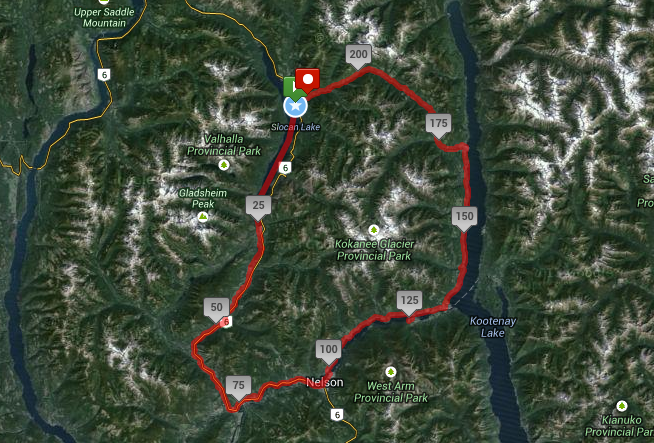
    Circle RouteThis circle route is one of those off-the-beaten-path gems. We live at the northwest corner of it. Once they widened the road at Cape Horn (at km 25 on the map) in the early 1990s, the motor homes began trundling through in ever greater numbers. Motorcyclists discovered it a decade or so ago and from the May long weekend until Labour Day we hear them droning by on the highway in clusters.

    When we first moved here I used to think about bicycling it. Could I do it in a day? I never tried. Life was too busy.

    In the depths of last winter, while bemoaning the fact that I wouldn’t be able to participate in SufferFest this year due to family conflicts, it suddenly occurred to me that I could turn the circle route into an endurance triathlon of sorts. Rather than taking roads the whole way, I’d do my first day on the lake in a kayak and day 2 would be a trail run along the Slocan Valley rail trail. The next day would be road-running from the bottom of the Slocan Valley over through Nelson and up the north shore of the West Arm of Kootenay Lake. And the last day would have me on my bicycle heading through Kaslo and over the pass back home.

    I had originally hoped to carve out time at the end of June. But family and SVI responsibilities piled on. Then I had be around to get Erin when she got back from Europe, and then Fiona was asked to help out with the Music Explorers program, and had the Dance program to do, the combination taking up two weeks. So here we are in the third week of July already and I haven’t set out, nor have I really committed to doing it. Until today.

    I’ve worked really hard to get the SVI administrative stuff done. Noah is solid with his work schedule. Sophie has just started her job, but she’s confident she can get back and forth by bike or on foot as needed. Fiona and Erin will be having a low-key few days at home. Erin has one gig, but I’ve organized a ride for her. Chuck will be on call. Provided I stock the fridge and pantry with lots of food, I have their blessing to leave. So I booked a place to stay for the first night and arranged to rent a kayak and — gulp! — I think I’m going.

    I have no doubt that I can manage each leg of the challenge on its own. What worries me is putting them together in the space of three or four days. What will I feel like on the morning of the third day, having run 70 kilometres over the previous day and a bit, facing 35 more and then a bike ride over the pass?

    I suppose I’m going to find out.

  • Five years of running

    I run. Come rain or snow or slush or all three, I run. I have no particular goals. I have no races planned, I don’t track my mileage any more, nor do I measure my pace or keep track of how often I run barefoot, or how many days a week I run. I’d guess that on average this winter I’ve run about 5k a day, sometimes more, sometimes less, sometimes not at all. But usually I run.

    It was almost exactly five years ago that I started making time to run. I’ve done a Half Marathon, a few 5 and 10k races, a Marathon and a couple of 25k trail races. I’ve usually placed pretty well, in the top 25% in my age-and-gender group, sometimes higher. But this year I don’t think I’ll be doing any organized runs or races at all. That’s just the way it’s worked out: there’s not much happening in the region, and what is available is at impossible times for me. Nor do I feel like spending hundreds of dollars, working out countless family-oriented logistical considerations and travelling hundreds of kilometres in order to test myself against someone else’s timer and a bunch of strangers.

    I’ve had my share of injuries, that’s for sure. I suppose that’s the price I pay for jumping into running at age 45 after fifteen years of not doing any such thing. The first year I had a mysterious deep hip pain that kept me from running and carrying heavy objects for almost three months and then miraculously resolved. A year later I hurt my foot scrabbling about barefoot (not running) and had to quit running for a couple of months to let it heal. And the then I developed a waxing and waning discomfort in the area of my left achilles tendon that has kept up ever since.

    A bunch of numbers that mean something or other.

    I have never really been able to figure out what’s going on in my ankle, because it didn’t behave a lot like a tendinitis or a bursitis. So I finally sought out a physiotherapist with a special (barefoot-friendly) interest in running biomechanics. She found a few little things in my biomechanics that needed work (my left hip abductors were much weaker than the right, which was weird but consistent), and I had a lot of mobility loss in my ankle as a result of two years of favouring it. Eventually after a bit of bewilderment she decided I was possibly suffering from a tarsal tunnel impingement, sort of like the ankle equivalent of carpal tunnel syndrome. Whether she was right or not, the active release therapy she did helped a bit, the prescribed exercises drastically increased my strength in some of the stabilizing muscles, the ankle problems are currently mild and manageable, and they no longer seem to be significantly aggravated by running. So that’s good. I still hurt a bit sometimes, but it doesn’t seem likely that I’m doing damage by continuing to run on an occasionally sore ankle.

    Ink’nBurn pretend-denim-jean capris and butterfly camisole. So nice!

    These days the stuff I use to run is as follows:

    • minimalist footwear most of the time: New Balance Minimus Trail shoes or Xero Shoes Sensori huaraches. Otherwise, if weather and terrain promise to be kind, bare feet.
    • my Fitbit Flex, because I like the feedback I get about overall activity level throughout a complete 24 hour day
    • For clothing, typically stuff from Lululemon and Ink’n’Burn. Most people are familiar with Lulu, but I think I like INB even better. Such amazing designs, with all the clever tech features I like. Neither are cheap.

    That’s all. No GPS, no stopwatch, no iPod or earbuds, no heart rate monitor. Not unless I’m on the treadmill.

    Would you run here?

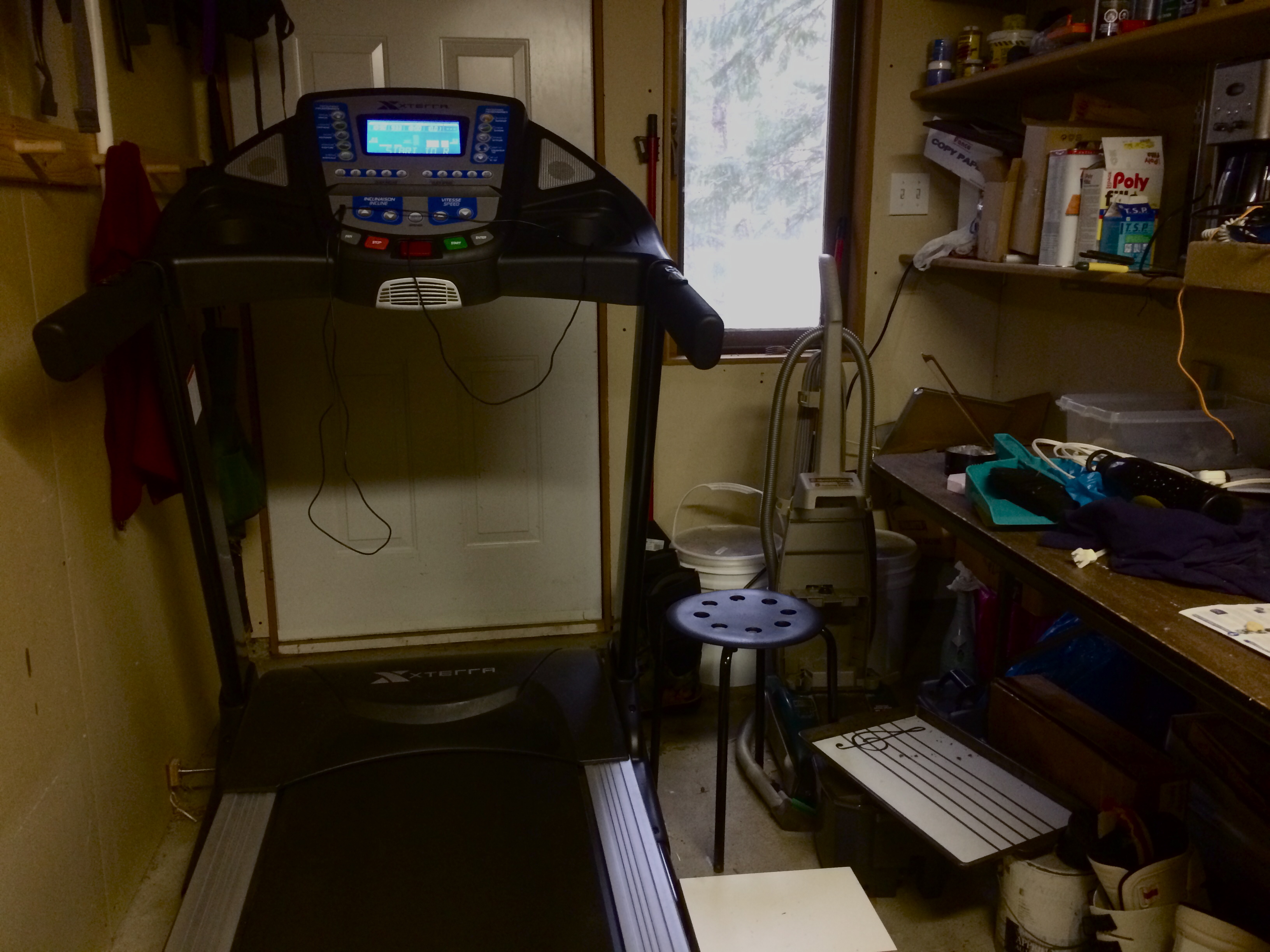
    Speaking of the treadmill, I’m so grateful for it. It’s boring as heck, especially situated where it is against a wall and a door in the dark basement, crowded in from all sides by paint cans, home repair stuff, Chuck’s various hoarded things, old sports gear and the bokashi bins. But I feel crappy when I don’t get to run, and on days when it’s too late or too gross or too complicated to get outside for a run, it’s a great substitute. I also think that being able to do ten- or fifteen-minute runs two or three times a day has really helped my ankle improve this winter.  Running outside is just a big enough production in winter to make it best-suited to runs of 30 minutes or longer.

    Where am I going from here? Well, nowhere, really. I’m just going to keep running, doing what feels right from day to day. I definitely want to explore more of the amazing terrain in this area, whether by running, hiking or camping. And I want to continue to be able to move myself over long distances under my own steam, inspired by the wisdom of this quote from Born to Run:

    “You don’t stop running because you get old. You get old because you stop running.”

  • Shibori

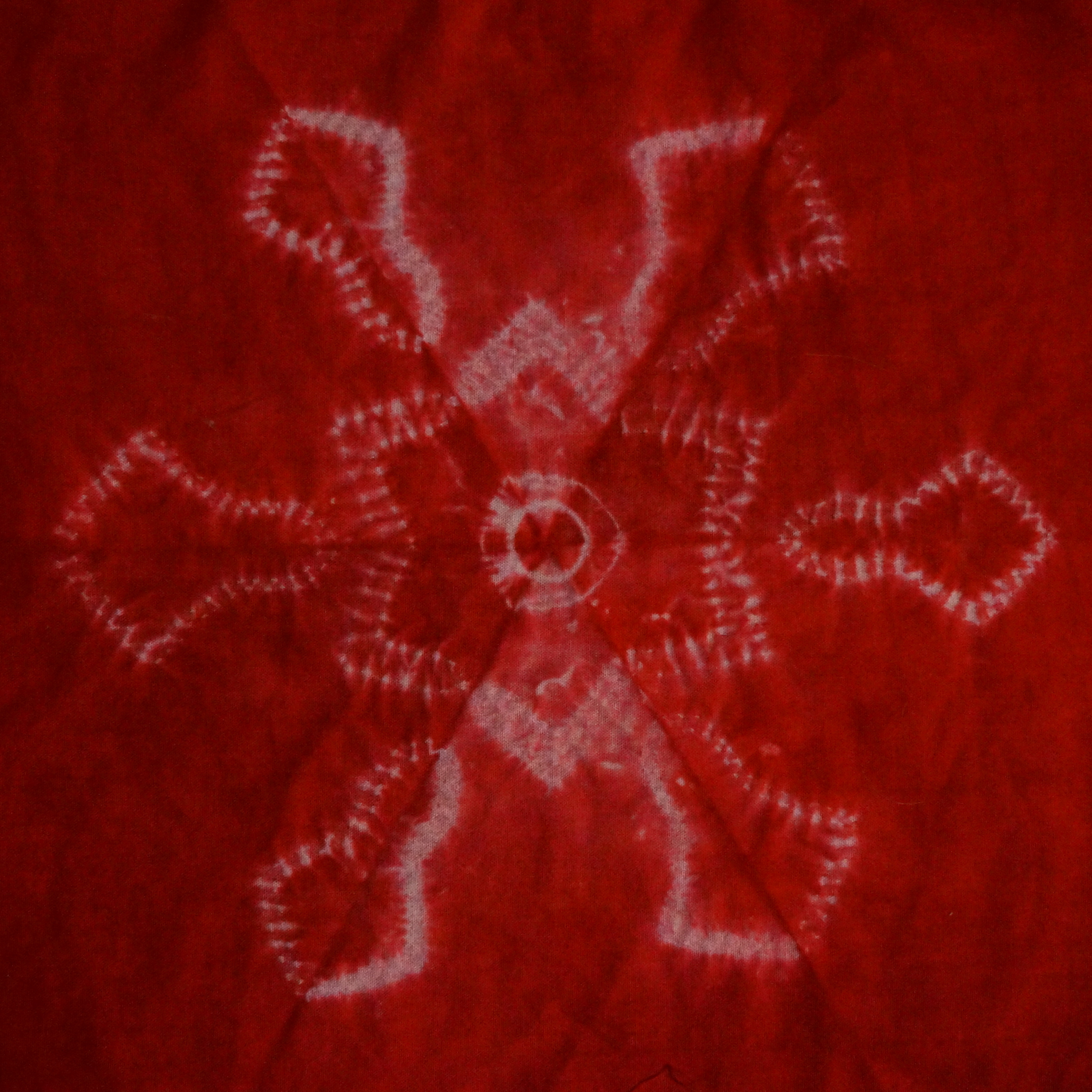
    Inspired by the introduction to shibori that Fiona got at her homeschoolers’ art class, I began sewing and tying a couple of dozen squares of cotton fabric to do my own experiment with the technique. I started this in July of 2012 and then set it aside, about two-thirds completed. I recently dug it out, finishing sewing and tying the last few squares, and then did the dyeing. It was so exciting to pull out the threads I had tied almost two years ago, not remembering what I’d had in mind at the time, not knowing what designs and patterns I’d used.

    Shibori is an old Japanese resist technique for fabric dyeing. It was originally developed by peasants who hadn’t the means to purchase woven patterned fabric. Traditionally indigo dye is used. In my case I have an idea for a quilt sashed with various washes of indigo-dyed recycled denim, punctuated by bright eye-catching squares of various shibori patterns, so I chose a deep red for the dyeing. I will probably regret my choice of denim, because of its heavy weight and the technical problems that will create when piecing a quilt top, but I suppose if it ends up feeling impossible I can buy some chambray and use that instead.

    There are numerous shibori stitching, folding and tying patterns. I gleaned some of my ideas from the internet, and invented or adapted others. Perhaps the quilt top will take another couple of years to come together, but I’ve had a lot of fun already and feel really satisfied with the results.

  • Owl encounter

    We heard that an injured owl had been found semi-conscious being mobbed by crows in the parking lot of our local grocery store. It had been whisked away and left with Rob, who, along with his wife Linda, is a bit of a birder. So we dropped by the café Rob runs to see if we could have a look. The owl was being kept quiet and warm elsewhere while Rob tried to figure out what to do with it. It turned out that the Orphan WildLife (OWL) rehab centre on the coast was willing to take the owl, and that transport had been arranged through the Trail airport, but that someone was needed to take the owl there for a 4 pm flight.

    Having already planned to swing through Castlegar at about 5 pm to find Fiona some dance wear on our way to gymnastics, we volunteered to go a couple of hours early and drive the 25 minutes out of our way to drop the owl off.

    He was a great horned fellow, alive and thumping around a little bit in his closed box, but mostly seeming quiet. We were warned that these guys have nasty talons and a grip strength of up to 300 psi, and so not to open the box under any circumstances. We loaded him into the back of the van and headed out. We didn’t get to really look at him, since he was all enclosed, but I did push my iPhone through the breathing hole and take this picture. All puffed up from stress, shying away from the light of my phone. I left him alone after seeing that. Poor guy. But beautiful!

    When we arrived in Trail we were surprised to find a local friend waiting for her own medical transport on the same flight. They departed together.

    After they left we spent a few minutes updating Rob and Linda, and the veterinary clinic that had offered to overnight the bird if there hadn’t been room for him on the flight, and the OWL Rehab centre, whose volunteers were amazingly helpful and efficient and were already en route to meet him at the other end.

    Then we bought dance shoes, tights and leotard (very exciting!) and went to gymnastics.

    Although our friend did well with her surgery, we found out a few days later that the owl did not fare so well. He was vastly underweight due to a broken leg that had presumably been preventing him from hunting for some time. He did begin eating well, but an xray revealed that his leg was shattered beyond repair, so he had to be euthanized. A lot of people did their best to help, but it just wasn’t to be.

    If you’re in the Lower Mainland, I’m told that the OWL Rehab Centre has excellent educational tours. That will be one of our stops the next time we’re in the neighbourhood.